The First-to-Second Order Playbook
The 45-day retention framework that determines lifetime value—and the exact sequences we use to maximize conversion.
Most brands obsess over acquisition. Few engineer the second purchase.
Here's the uncomfortable truth: the majority of your customers will never buy again. Industry data shows 60-70% of first-time buyers become one-and-done. They cost you money to acquire, bought once, and vanished.
The first 45 days after purchase determine whether a buyer becomes a liability or an asset.
This isn't about "customer loyalty" platitudes. It's capital efficiency. The difference between a brand that scales profitably and one that bleeds cash on endless acquisition sits in this single metric: second purchase conversion rate.
This is the exact framework we deploy to turn that window into a revenue system.
Why the Second Order Is the Real Profit Inflection Point
Let's run the math that acquisition-obsessed brands ignore.
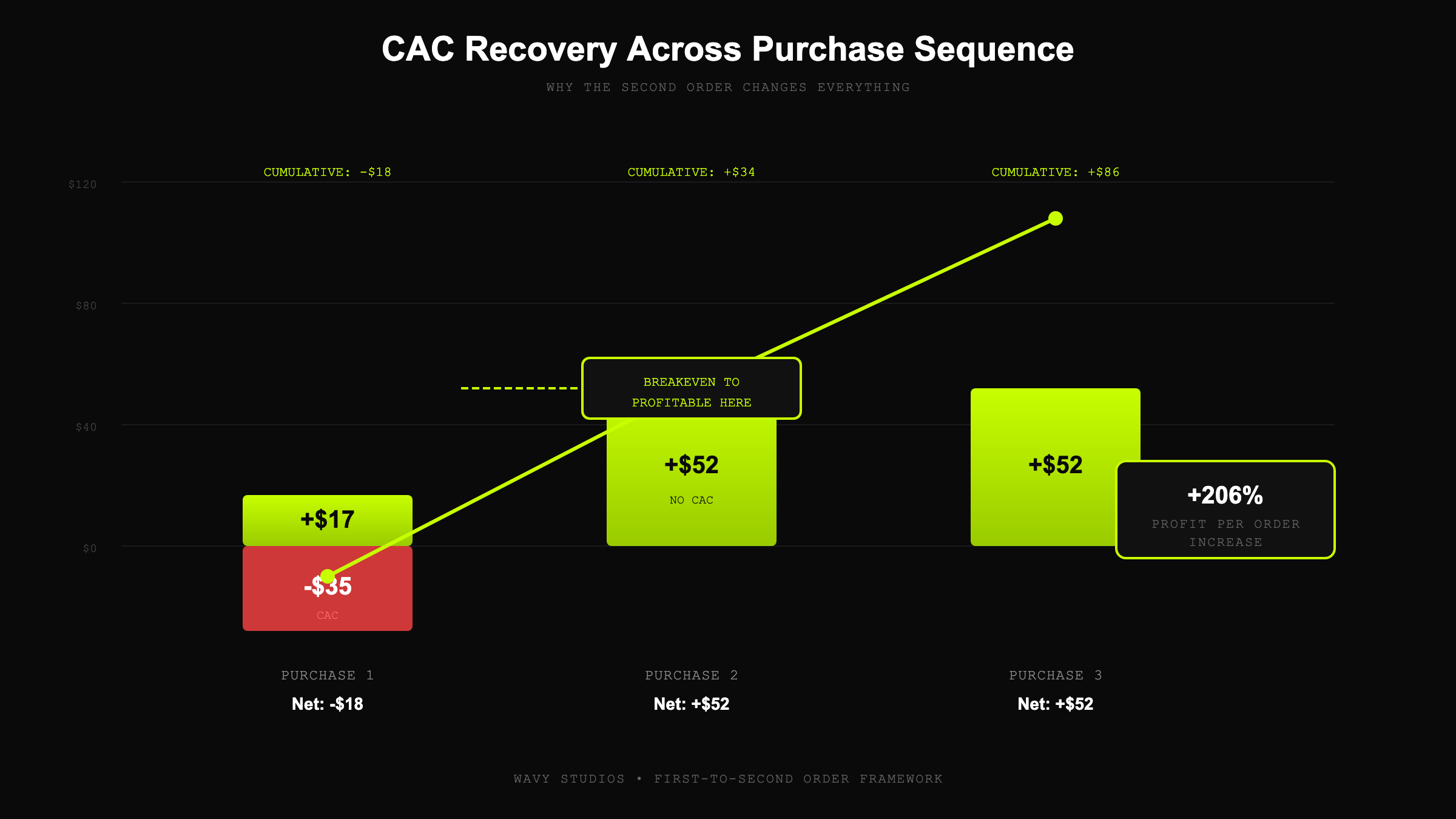
Scenario: $80 AOV brand, 65% gross margin, $35 CAC
| Metric | First Order | Second Order |
|---|---|---|
| Revenue | $80 | $80 |
| COGS (35%) | -$28 | -$28 |
| Gross Profit | $52 | $52 |
| CAC | -$35 | $0 |
| Contribution | $17 | $52 |
The first order generates $17 contribution. The second generates $52—a 206% increase in profit per order with zero incremental acquisition cost.
This is why retention isn't a "nice to have." It's the mechanism that determines whether your unit economics work.
The payback math:
- At $17 contribution per first order, CAC payback takes multiple purchases
- A customer who buys twice has now contributed $69 to the business
- A customer who buys three times contributes $121
The gap between a 25% second-purchase rate and a 35% second-purchase rate compounds into millions at scale.
Every 10-point improvement in second order conversion increases effective LTV by 40%+ and expands your tolerable CAC ceiling proportionally. This is how brands unlock aggressive acquisition while competitors stay defensive.
The 45-Day Retention Window Framework
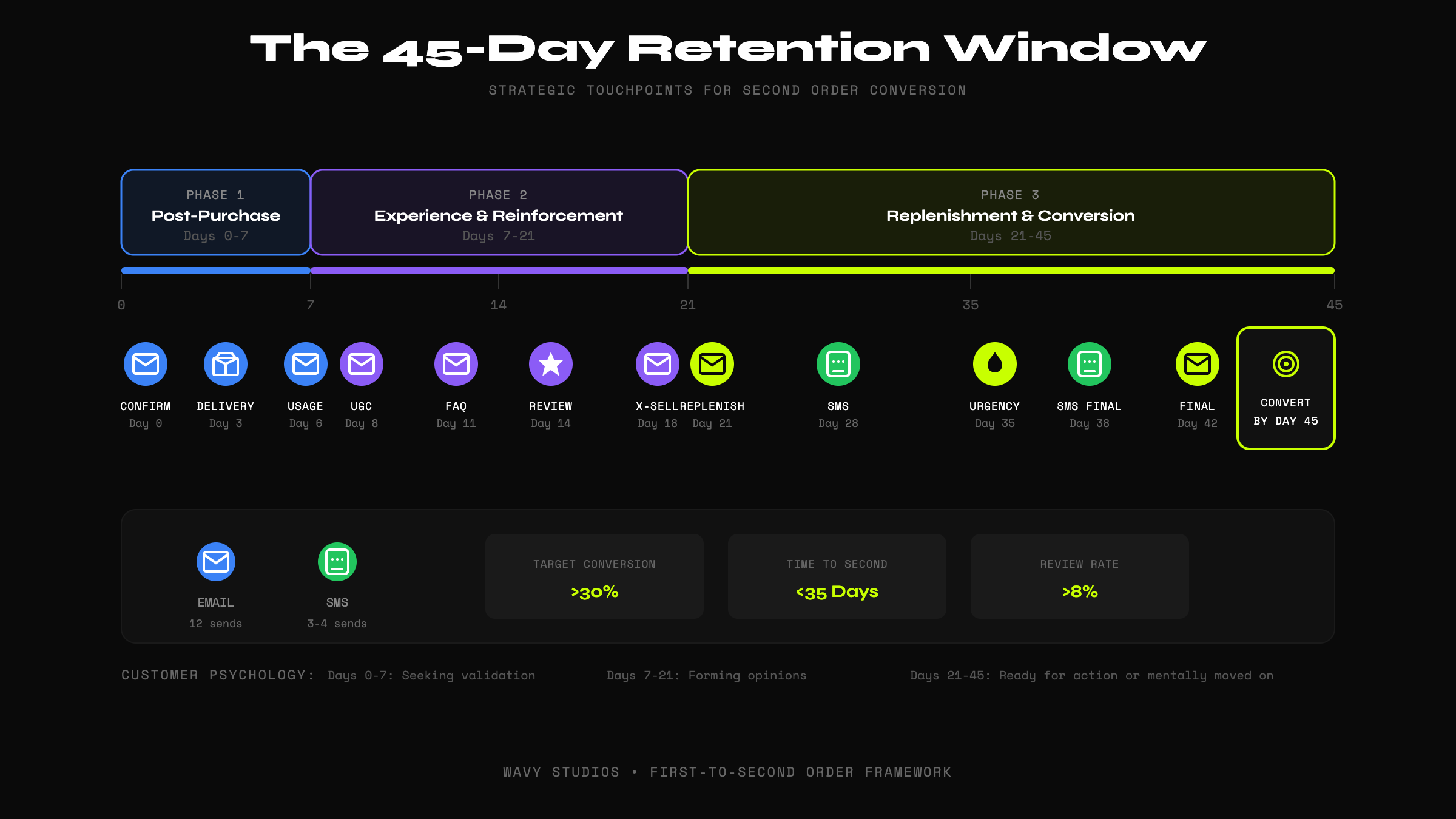
Forty-five days isn't arbitrary. It's the window where:
- Product experience is still fresh
- Brand memory hasn't decayed
- Replenishment timing hits for most consumables
- The psychological commitment to "being a customer" can be cemented
After 45 days without a second purchase, win-back costs spike and conversion rates crater. You're no longer nurturing—you're resurrecting.
Immediate Post-Purchase (Days 0-7)
Product Experience & Reinforcement (Days 7-21)
Replenishment & Cross-Sell Window (Days 21-45)
The Exact Email Flow Architecture We Use
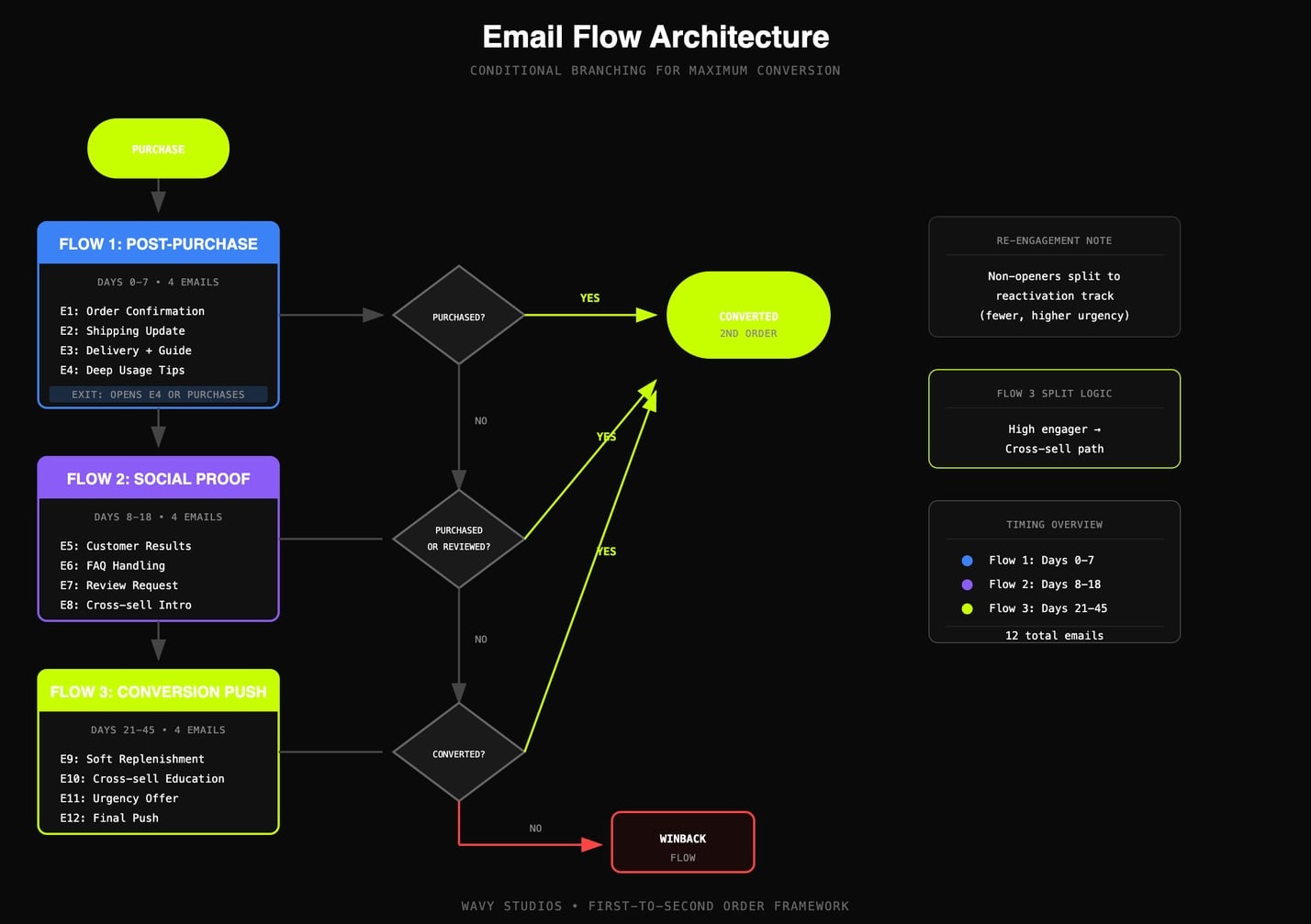
Generic flows underperform. Here's the tactical structure:
Flow 1: Post-Purchase Education (Days 0-7)
Flow 2: Social Proof & Objection Handling (Days 8-18)
Flow 3: Replenishment & Conversion Push (Days 21-45)
Subject Line Philosophy:
- Specific > clever
- Benefit-forward
- Creates curiosity without clickbait
- Examples: "Day 3 with [Product]—here's what to do" / "Running low? Most customers reorder now"
SMS Strategy: Where It Accelerates the Second Order
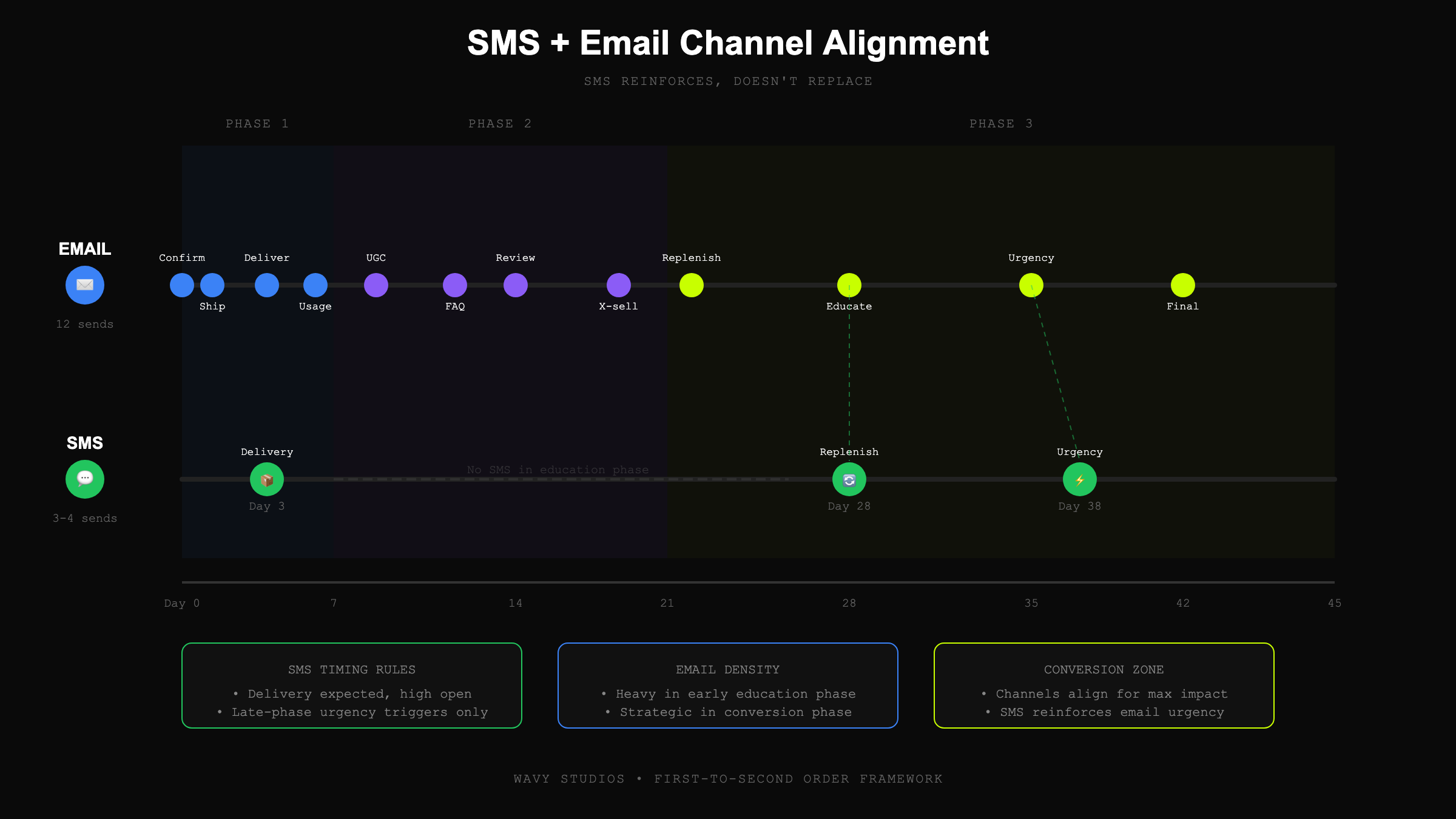
SMS is a scalpel, not a hammer. Misuse it and you burn the list.
When SMS Works
- Shipping and delivery updates (expected, high open)
- Time-sensitive offers (24-48 hour windows)
- Replenishment at exact consumption timing
- Back-in-stock for previously browsed items
- High-intent behavioral triggers (cart activity, browse abandonment)
When SMS Fails
- Educational content (wrong format)
- Brand storytelling (they don't want it there)
- Frequent promotional blasts (instant unsubscribe)
- Anything that feels interruptive without urgency
Compliance Reality: SMS opt-in is harder to get and easier to lose. A 2% unsubscribe rate per campaign is a death spiral. Segment aggressively. Send less. Convert more per send.
Our SMS Timing:
- Day 2-4: Delivery notification
- Day 28: Replenishment nudge (consumables only)
- Day 38: Urgency offer (engaged segment only)
Three to four SMS touches in 45 days maximum for non-VIP customers.
Behavioral Segmentation and Dynamic Branching
Static flows treat all customers identically. That's leaving money on the table.
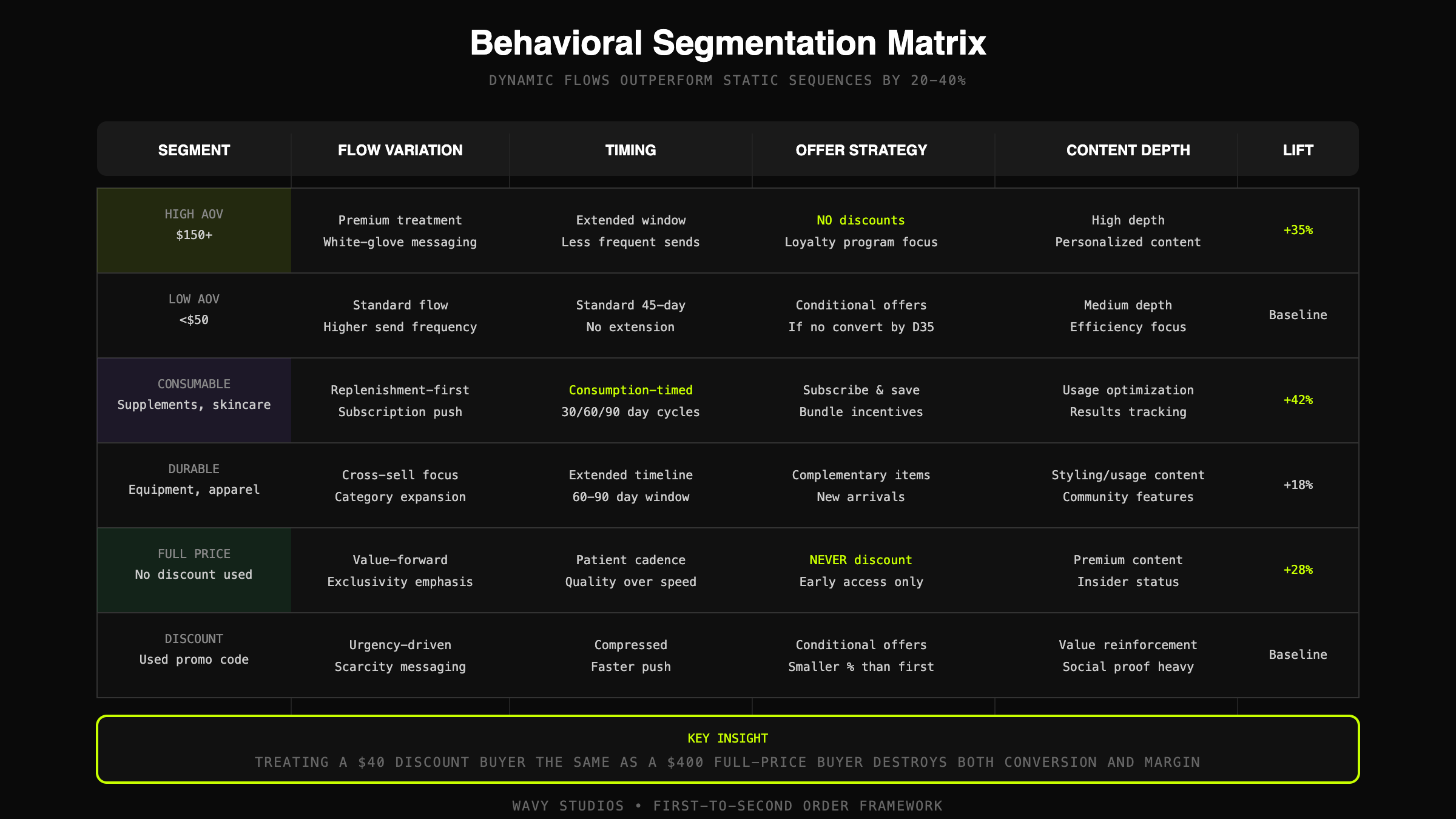
Dynamic Flow Logic:
The second purchase push for a customer who bought a $120 skincare set at full price looks nothing like the push for someone who bought a $35 item on 20% off.
Segment 1 gets premium cross-sell education, loyalty program early access, and no discounting.
Segment 2 gets urgency-driven replenishment with a conditional offer if they haven't converted by Day 35.
Conversion lift from dynamic branching vs. static flows: 20-40% in our deployments.
Metrics That Actually Matter in the First 45 Days
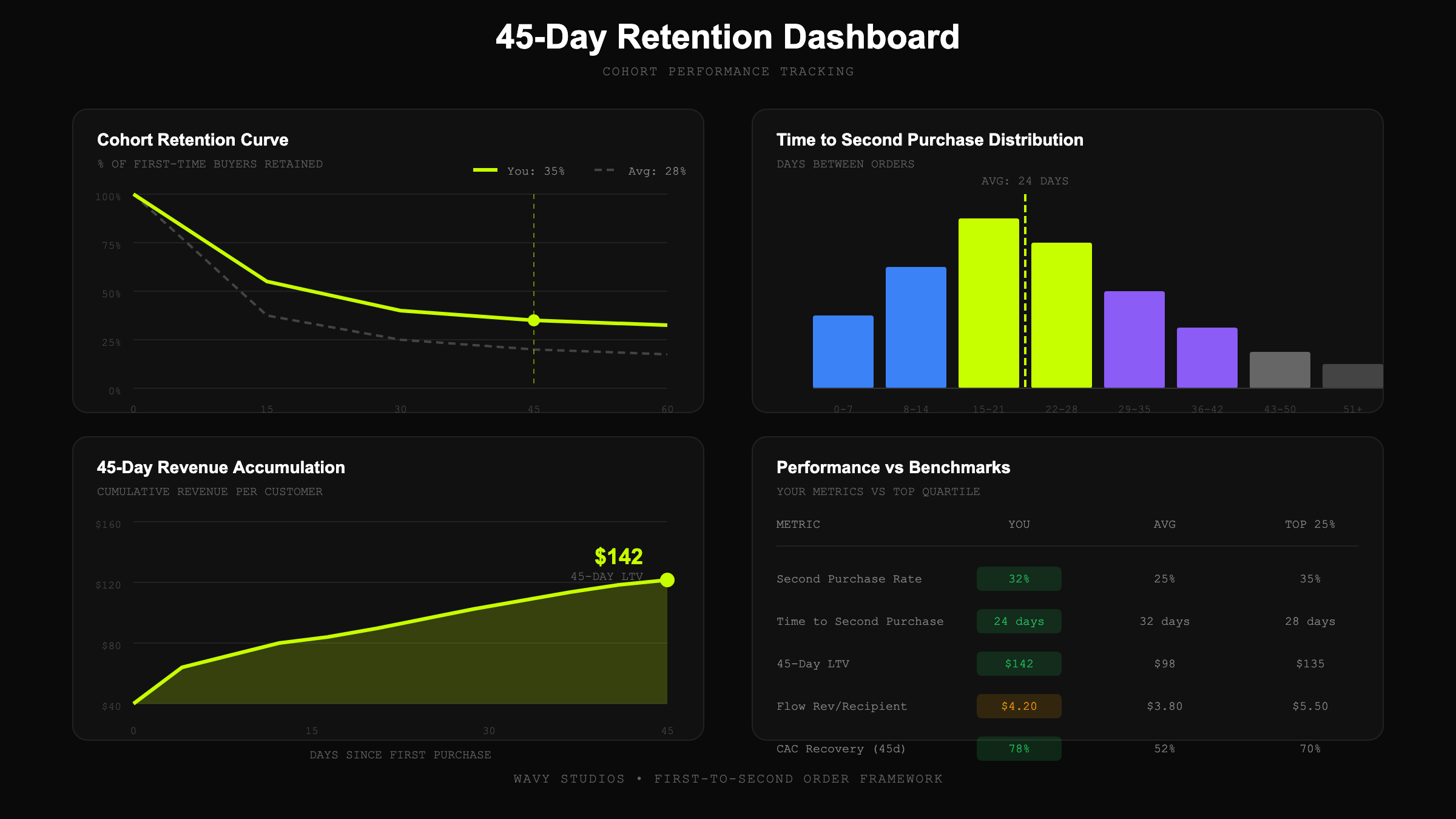
Vanity metrics hide problems. These expose them:
Second Purchase Rate (45-day cohort)
The north star. What percentage of first-time buyers convert within 45 days? Benchmark: 25-35% for strong operators.
Time to Second Purchase
Average days between first and second order. Compression here = faster payback. Target: <30 days for consumables.
45-Day LTV
Revenue per customer within the window. Track by acquisition source to identify quality variance.
Flow Revenue Per Recipient
Revenue generated per person entering each flow. Identifies which sequences carry weight.
Contribution Margin Recovery Rate
What percentage of CAC is recovered within 45 days? This connects retention directly to acquisition tolerance.
SMS Incremental Lift
A/B test holdouts to measure true SMS contribution. If it's not incrementally profitable, reduce frequency.
Common Retention Mistakes That Kill Second Purchase Rates
Over-Discounting
Training customers to wait for offers. Every discount on the second purchase reduces margin and sets expectations. Use urgency and value-adds before defaulting to percentage off.
Too Much Education, Not Enough Conversion
Some flows read like a course syllabus. Customers don't need 12 emails about product philosophy. They need a reason to buy again.
Ignoring Consumption Timing
Sending replenishment emails when the product isn't used up yet. Or worse, after they've already repurchased elsewhere.
Treating All SKUs Identically
A customer who bought protein powder has different needs than one who bought a gym bag. Product-specific flows outperform generic ones.
No Urgency Mechanisms
Every email politely suggesting they "come back when ready." Without scarcity, deadlines, or consequence, there's no reason to act now.
Poor Segmentation
Blasting the same sequence to a $40 buyer and a $400 buyer. One needs nurturing. One needs white-glove treatment.
Operator Implementation Checklist
-
Audit current time to second purchase Know your baseline before optimizing
-
Map product consumption windows When does each SKU run out?
-
Build the 45-day timeline Plot every touchpoint across channels
-
Create segment definitions AOV tiers, product types, behavior signals
-
Build flow logic with conditional branching No static sequences
-
Align SMS to high-intent moments only Fewer sends, higher impact
-
Define success thresholds What's good enough? What triggers optimization?
-
Schedule monthly cohort reviews Track by acquisition month, compare trends
This isn't a campaign. It's infrastructure. Build it once, optimize continuously.
The first purchase buys attention.
The second purchase builds a business.
Brands that engineer the 45-day window don't compete on CAC. They compete on how much they can afford to spend on CAC—because every customer is worth more.
That's the game. And most brands aren't playing it.
Ready to engineer your retention system?
Book a strategy call and we'll audit your post-purchase flows together.
Book Your Strategy Call →