Why Your Welcome Series Is Leaving Money on the Table
The 8-email welcome flow that outperforms every "best practice" template we've tested against.
Your welcome series is the highest-intent traffic you will ever own.
And most brands waste it with three emails and a discount.
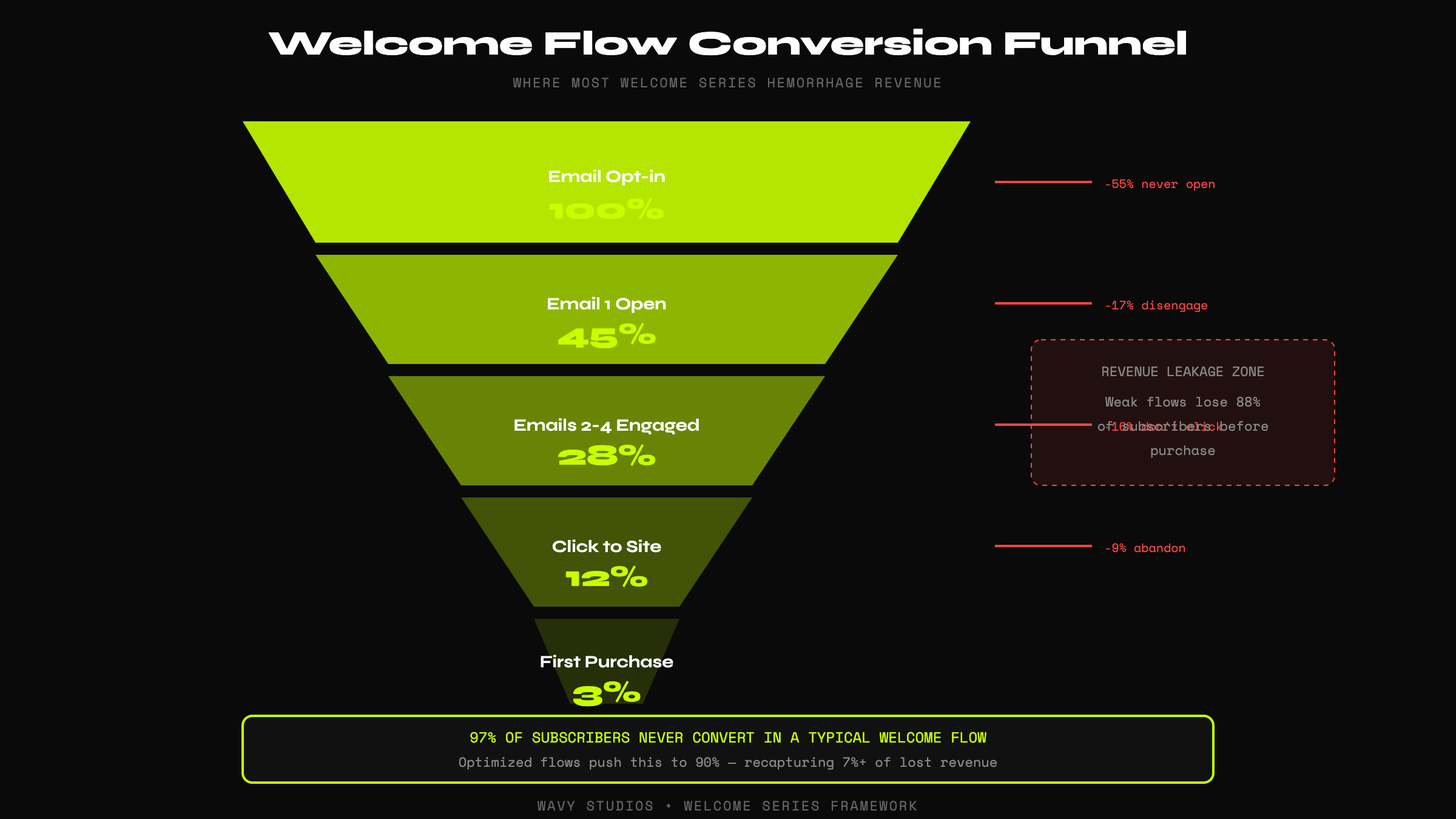
Here's what the data says: new subscribers have 3-5x higher engagement rates than your general list. They opted in with intent. They're actively evaluating. The window is open and it closes fast.
Yet the average ecommerce welcome flow converts at 2-4%. The best operators push 8-12%+. That's not a marginal difference. That's the difference between CAC recovery in 30 days versus 90.
Your welcome series isn't a branding exercise. It's CAC recovery infrastructure.
This is the 8-email framework we've tested against every "best practice" template and why it consistently outperforms.
Why Most Welcome Series Structurally Underperform
The problem isn't creative. It's architecture.
Most welcome flows fail because they're built on assumptions that don't survive contact with subscriber psychology:
Too Short
Three to four emails isn't enough touchpoints to move someone from awareness to purchase. You're leaving before the conversation is over.
Over-Discounting
Leading with a discount trains subscribers to wait for offers. Worse, it attracts discount-seekers who churn fast and destroy LTV.
No Objection Handling
Subscribers have doubts. If you don't address them, they don't magically disappear. They just block the purchase.
No Segmentation
Treating a high-intent clicker the same as someone who never opened is leaving conversion on the table.
Treating Subscribers Like Buyers
They're not customers yet. They're evaluating. The messaging needs to acknowledge that gap.
The Second-Order Consequences
- Lower AOV: Discount-led flows anchor price expectations
- Delayed first purchase: Weak flows push conversions to 30-60 days instead of 7-14
- Weak brand authority: Generic messaging fails to differentiate
- Poor LTV trajectory: First purchase behavior predicts lifetime behavior
The welcome window is where customer quality is determined. Waste it, and you're fighting uphill forever.
The Economics of the Welcome Window
Let's make this financial.
You paid to acquire that subscriber. Whether through paid social, content, or partnerships, there's a cost. Call it Subscriber Acquisition Cost (SAC).
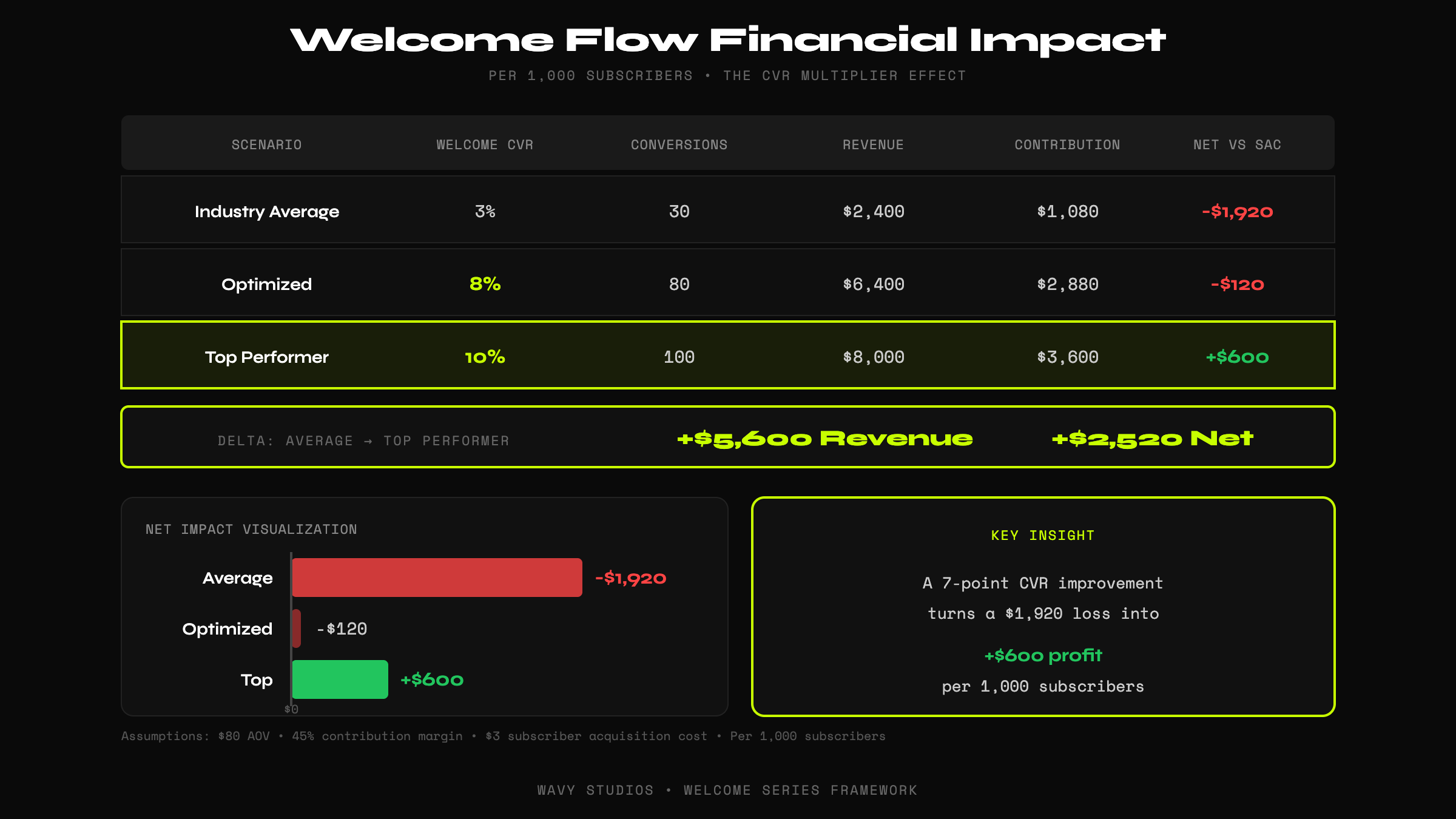
If your SAC is $3 and your welcome flow converts at 3% with a $80 AOV and 45% contribution margin:
- 1,000 subscribers = $3,000 acquisition cost
- 30 conversions x $80 = $2,400 revenue
- $2,400 x 45% margin = $1,080 contribution
- Net: -$1,920 loss on the welcome window
Now increase welcome CVR to 8%:
- 80 conversions x $80 = $6,400 revenue
- $6,400 x 45% margin = $2,880 contribution
- Net: -$120 (nearly breakeven)
Push to 10%:
- 100 conversions x $80 = $8,000 revenue
- $8,000 x 45% margin = $3,600 contribution
- Net: +$600 profit
A 7-point CVR improvement turns a $1,920 loss into $600 profit. Per 1,000 subscribers. Every month.
This is why the first 7-14 days matter more than any other window in the customer lifecycle.
The 8-Email Welcome Series Framework
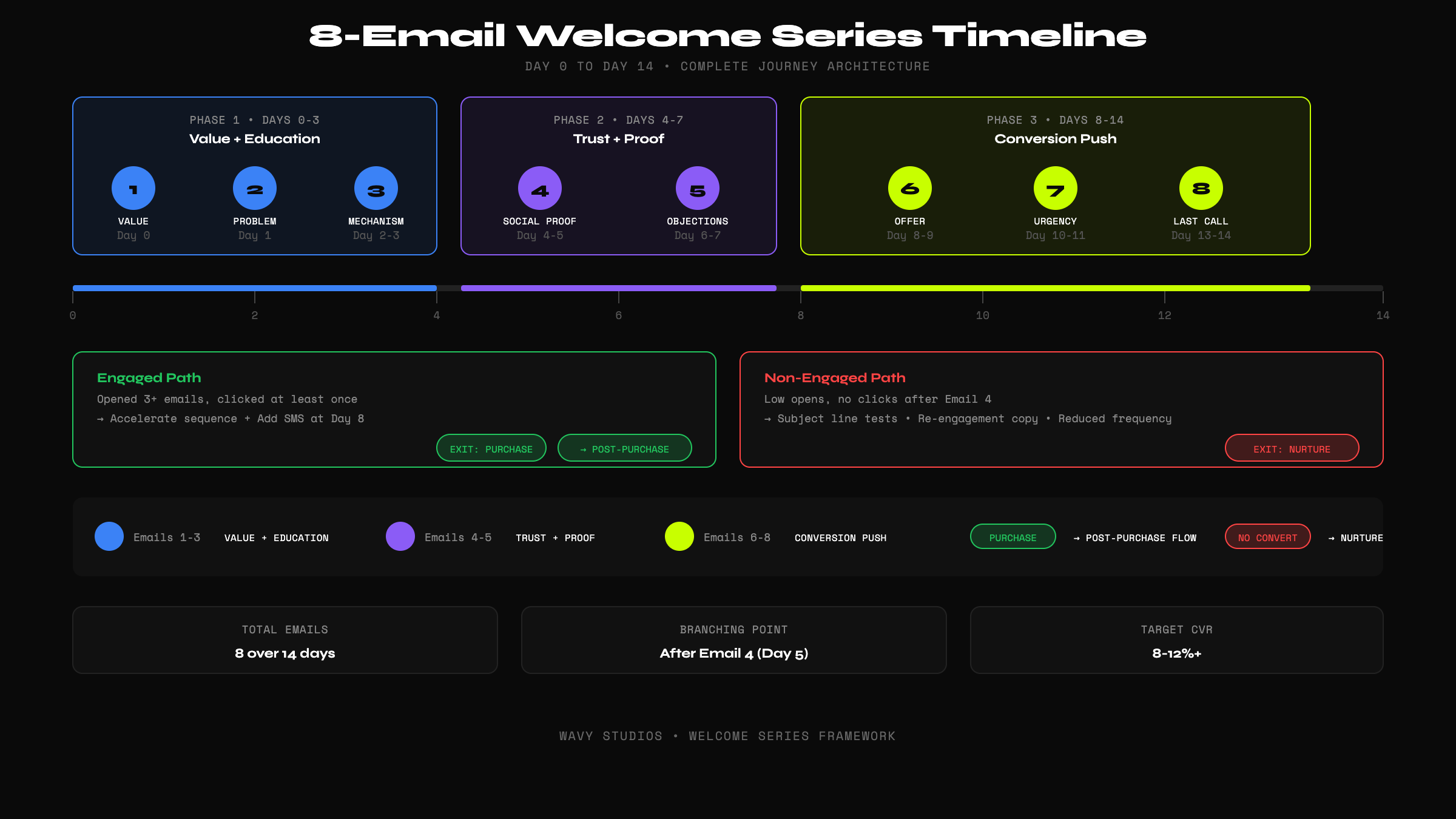
Here's the structure we deploy. Each email has a specific job in the conversion sequence.
Email 1: Value Anchor + Brand Positioning
This is not a discount email. It's a positioning email.
Email 2: Problem Agitation
People don't buy products. They buy solutions to problems.
Email 3: Mechanism Explanation
Specificity builds trust. Vague claims create doubt.
Email 4: Social Proof + Authority
Stack your proof: reviews, press, expert endorsements, UGC, results data.
Email 5: Objection Handling
Every product has 3-5 core objections. Address them preemptively.
Email 6: Offer Framing
Notice: this is email 6, not email 1. Now the offer has context.
Email 7: Urgency or Incentive
Incentives are closers, not openers.
Email 8: Last Call + Segmentation Exit
After 14 days, intent has decayed. Non-converters need a different approach.
Segmentation That Changes Everything
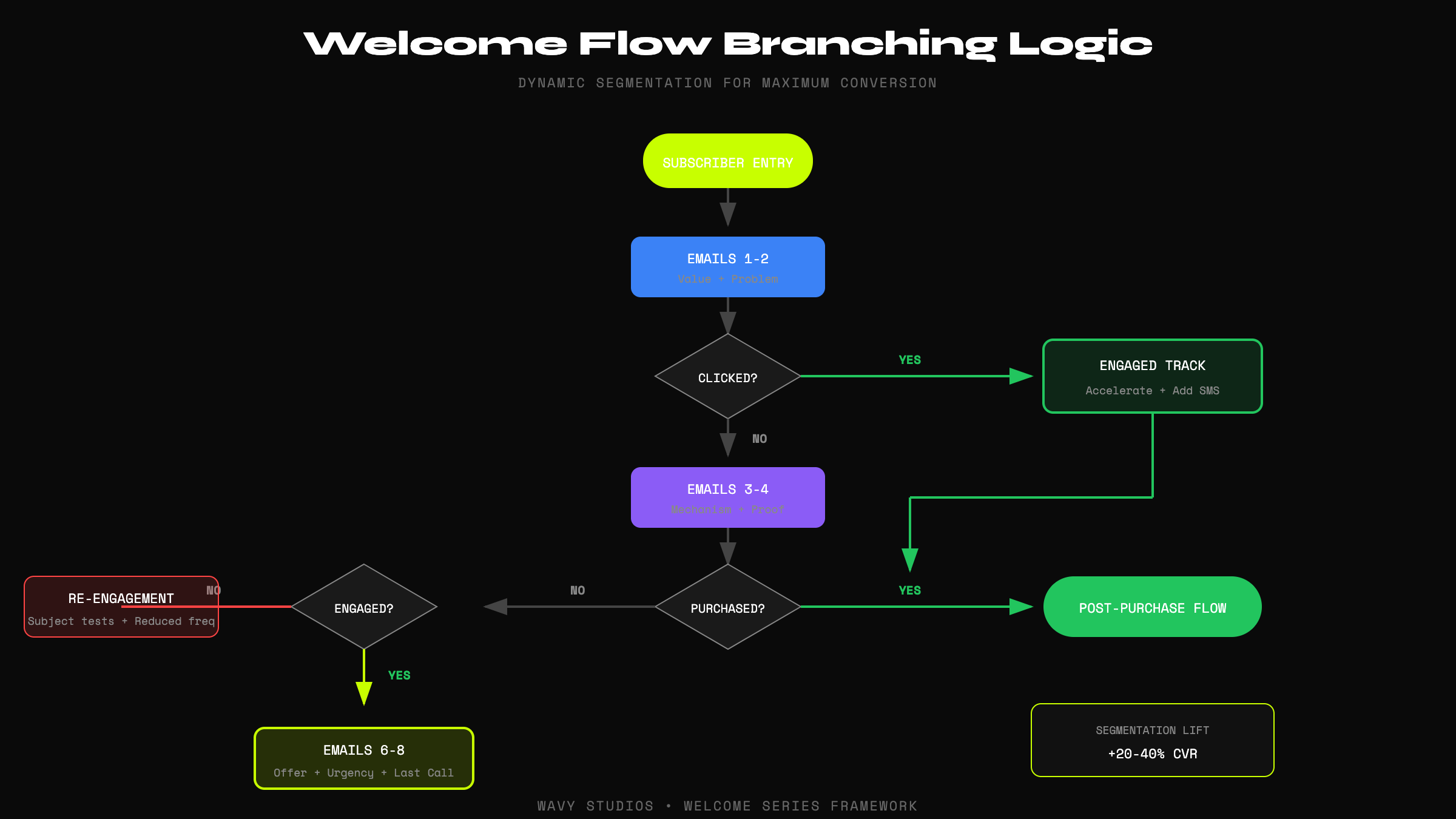
A static 8-email sequence is a starting point. Dynamic branching is where the real lift happens.
Engaged Non-Purchasers: Opened 3+ emails, clicked at least once, no purchase. Treatment: Accelerate to offer + add SMS touchpoint.
High-Intent Browsers: Clicked to site, viewed product pages. Treatment: Product-specific retargeting with social proof for viewed items.
Non-Engaged: Low opens, no clicks. Treatment: Subject line testing, re-engagement messaging, reduced frequency.
Discount Sensitive: Only engaged with discount messaging. Treatment: Value-first messaging to reframe expectations.
Category Interest: Clicked specific categories. Treatment: Category-specific content vs. generic.
The principle: behavior reveals intent. Match messaging to intent.
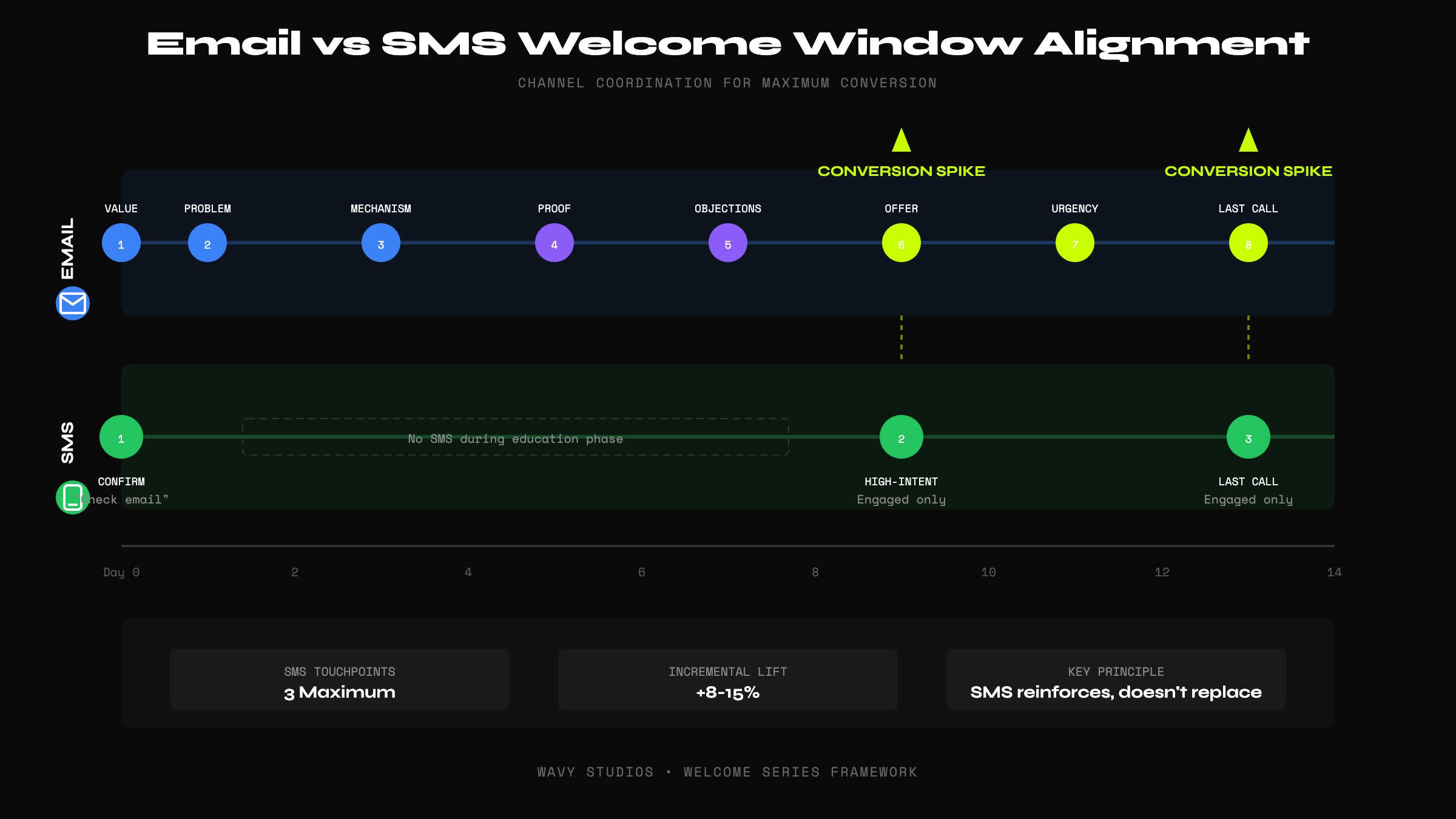
SMS Integration Without Cannibalization
SMS in the welcome window is high leverage if deployed correctly.
The Mistake: Sending SMS versions of every email. This creates fatigue and trains subscribers to ignore both channels.
The Right Approach:
SMS Touchpoint 1 (Day 0): Opt-in confirmation. "You're in. Check your email for [value promise]." Purpose: Drive email open, not conversion.
SMS Touchpoint 2 (Day 7-8): High-intent nudge for engaged non-purchasers only. Short, direct, links to offer.
SMS Touchpoint 3 (Day 13): Last call for engaged segment only. Final conversion push.
Three SMS touchpoints maximum. Aligned with email, not competing.
Incremental lift from SMS in welcome window: 8-15% when properly segmented.
Copy and Structural Testing Insights
After hundreds of welcome flow tests, patterns emerge:
Plain Text vs. Designed: Plain text wins for emails 1, 2, and 5 (personal, authority, objection handling). Designed wins for emails 4 and 6 (social proof, offer framing).
Founder Voice vs. Brand Voice: Founder-led messaging outperforms by 15-25% on early emails. People connect with people.
Long Form vs. Short Form: Email 3 (mechanism) performs better long. Emails 7-8 (urgency) perform better short.
Hard CTA vs. Soft CTA: Soft CTAs outperform in emails 1-3. Hard CTAs win in emails 6-8. Don't ask for the sale before you've built the case.
Social Proof Density: More is more, up to 5-8 proof points. Stack different types rather than repeating the same type.
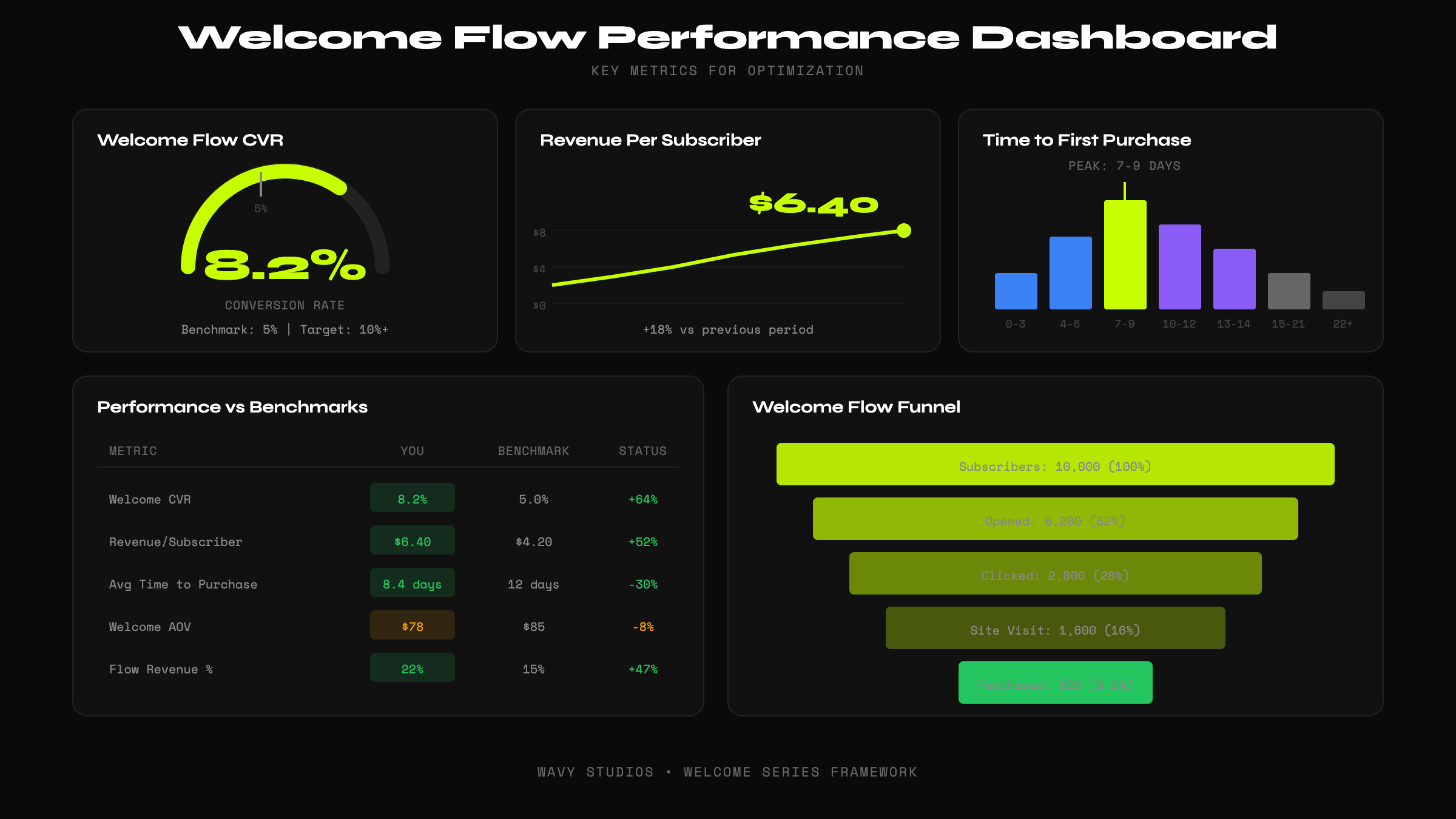
Metrics That Actually Matter
Welcome Flow CVR: Percentage who purchase within 14 days. Benchmark: 5-8% baseline, 10%+ optimized.
Revenue Per Subscriber: Total welcome revenue divided by subscribers entered. Your true flow value metric.
Time to First Purchase: Target under 10 days for consumables, under 14 for durables.
AOV Impact: If significantly lower than site average, discounting is too aggressive.
Flow Revenue Contribution: Welcome flow as % of total email revenue. Healthy: 15-25%.
Common "Best Practice" Myths
Myth: Fewer emails convert better
Reality: More touchpoints = more opportunities. 8 emails outperforms 3-4 consistently. The key is sequencing, not volume.
Myth: Always lead with a discount
Reality: Discount-led flows attract discount buyers. Lead with value; use discounts as closers for engaged non-purchasers.
Myth: Branding emails don't convert
Reality: Brand positioning directly influences downstream conversion. Skipping them reduces performance.
Myth: Design-heavy emails perform better
Reality: Depends on objective. Personal, text-forward emails outperform for trust-building stages.
Myth: One sequence fits all
Reality: Behavioral segmentation lifts CVR by 20-40%. Static sequences leave that on the table.
Your welcome series is not an introduction.
It's your highest-leverage revenue asset.
No other flow has this combination: maximum intent, defined window, controllable sequencing, measurable impact. Every percentage point improvement compounds across every subscriber you'll ever acquire.
The brands that treat welcome flows as strategic infrastructure, not template execution, are the ones that scale profitably.
Build accordingly.
Ready to rebuild your welcome series?
Book a strategy call and we'll audit your welcome flow together.
Book Your Strategy Call →