The Biggest Mistake I Made Scaling to $1M/mo
I thought I needed to diversify channels. I was wrong. Here's what actually unlocked scale.
The Moment I Thought I Had It Figured Out
We hit $400K/month and I was certain we'd cracked it.
Meta was printing. Creative was clicking. The team was executing. Every week felt like progress.
The question wasn't "how do we survive" anymore. It was "how do we scale faster."
And that's when I made the mistake that cost us six months and nearly $200K in wasted spend.
I decided we needed more channels.
Why Diversifying Felt Like the Smart Move
The logic seemed airtight.
Platform risk. What happens if Meta changes the algorithm? What if CPMs spike? We couldn't be dependent on one channel.
Revenue concentration. 85% of revenue from a single source felt dangerous. Every advisor I talked to said the same thing: diversify.
Peer pressure. Other founders were talking about TikTok, Google, influencer programs, affiliates. It felt like we were behind.
The narrative. "Don't put all your eggs in one basket" is business gospel. It sounds responsible. It sounds strategic.
So we did what felt smart. We split budget across Meta, Google, TikTok, and an influencer program. We hired specialists for each. We built creative pipelines for multiple platforms.
It felt like progress. It wasn't.

What Actually Happened
Within 90 days, everything got harder.
Focus diluted. Instead of one channel we understood deeply, we had four we understood superficially.
Team bandwidth strained. The same people who were crushing Meta now had to split attention. Quality dropped everywhere.
Creative fatigue. Building for one platform is hard. Building for four simultaneously is chaos.
CAC increased. We weren't bad at the new channels. We were mediocre. Mediocre performance at scale is expensive.
Decisions slowed. With data coming from everywhere, signal clarity disappeared.
We were working harder, spending more, and making less.

The Real Constraint I Was Ignoring
Here's what I finally understood: I wasn't constrained by channel. I was constrained by depth.
The problem wasn't that Meta couldn't scale further. The problem was that I hadn't maximized what Meta could actually do.
- Creative iteration was shallow. We were testing 10 concepts when we should have been testing 50.
- Offer testing was incomplete. We had one funnel, one landing page, one angle.
- Retention systems were underdeveloped. First-order economics were carrying everything.
- Audience expansion was lazy. We'd found one winning audience and stopped looking.
I thought we'd hit the ceiling. We'd barely touched it.
The mental model I was missing: Depth before breadth.
Going wide feels like progress because it's visible. New channels, new hires, new dashboards. But it's often just complexity masquerading as growth.
Going deep is invisible. More creative tests. Better landing pages. Stronger retention. It doesn't look impressive, but it compounds.

The Shift That Actually Unlocked Scale
We killed the new channels. All of them.
Reallocated 100% of budget back to Meta. Moved the specialists to creative and CRO. Simplified the entire operation.
Then we went deep:
- Creative velocity tripled. From 40 assets/month to 120.
- Landing page conversion improved 35%. Same traffic, more revenue.
- Post-purchase flows rebuilt. Second order rate increased from 18% to 29%.
- Offer testing systematized. We found three new winning angles.
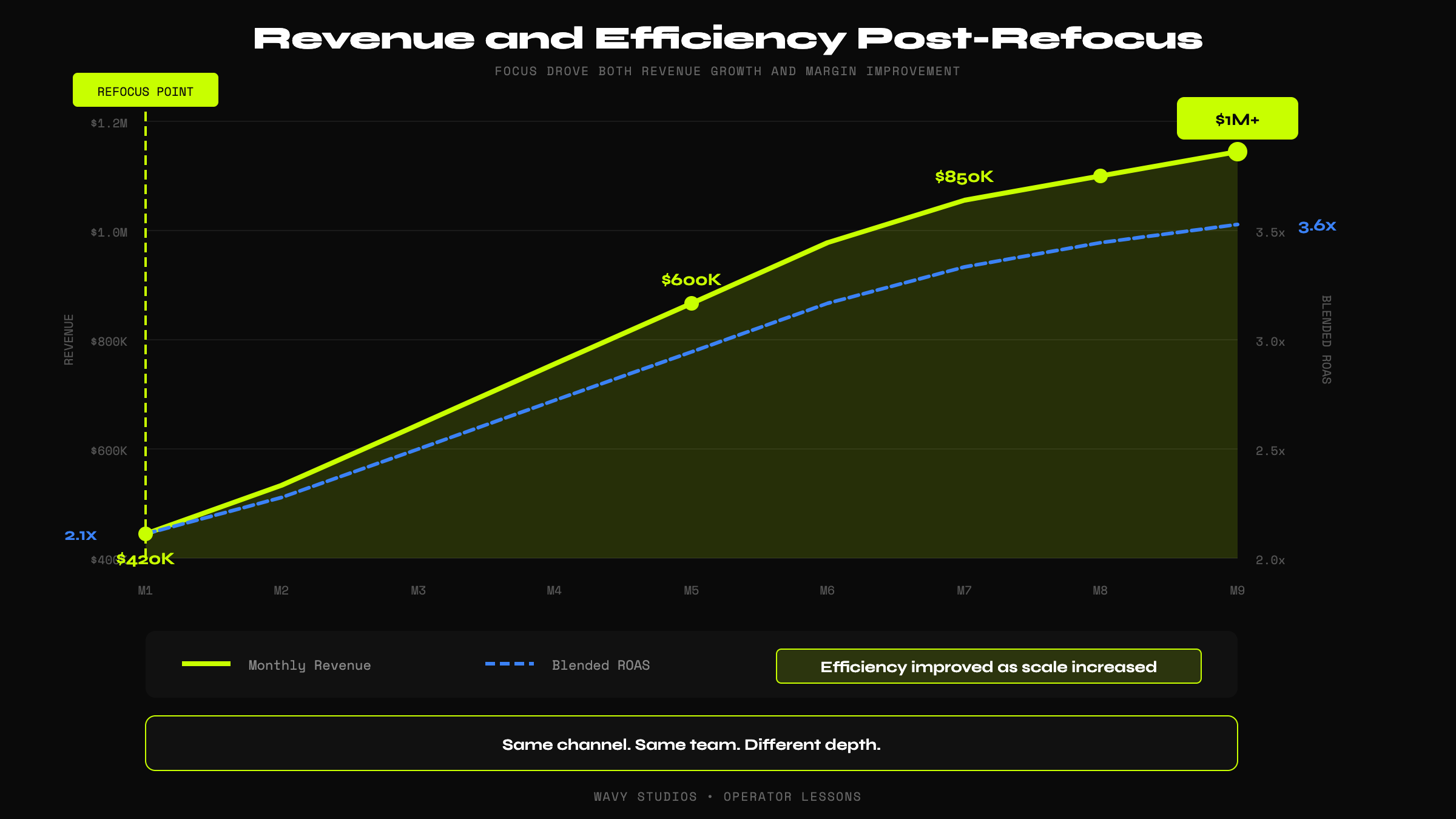
Within four months, we broke $600K. Two months later, $850K. By month ten, we crossed $1M.
Same channel. Same team. Different depth.
The Mental Model That Changed Everything
Optimization ceiling > Channel expansion.
Before you add a new channel, ask:
- Have we exhausted our creative angles? (If testing fewer than 50 concepts/month, probably not.)
- Is CAC rising because of saturation, or poor execution?
- Have we maximized conversion rate? (Most brands leave 20-40% on the table.)
- Is retention fully built? (If email/SMS is under 30% of revenue, there's headroom.)
- Are we actually out of audience, or just out of good creative?
If you can't answer "yes, we've maxed this out" to all five, you're not saturated. You're undertested.
When Diversification Actually Makes Sense
This isn't an anti-diversification argument. It's a timing argument.
Diversification makes sense when:
- You've genuinely saturated your primary channel
- Platform risk is real and imminent
- Your systems are mature enough to replicate
- Cash flow requires hedging
But if you're scaling and things are working, going wide is usually a distraction dressed up as strategy.
Operator Takeaways
- Focus compounds. The boring work of going deeper creates exponential returns.
- Complexity taxes performance. Every new channel costs attention, your scarcest resource.
- More channels does not equal more scale. Scale comes from efficiency, not surface area.
- Depth creates margin. Better conversion, retention, creative. All improve unit economics.
- Protect your attention. The best operators aren't doing more. They're doing less, better.
Scaling to $1M/month didn't require more channels.
It required going deeper where we were already winning.
The mistake wasn't trying to diversify. It was diversifying before we'd earned the right to. We mistook complexity for progress, and it cost us.
If you're at $300K, $500K, $800K and wondering whether to expand channels, ask yourself honestly: have you actually maxed out where you are?
For most operators, the answer is no.
Go deeper first.
Ready to go deeper on your primary channel?
Book a strategy call and we'll find the untapped scale in your current setup.
Book Your Strategy Call →