The 70/20/10 Budget Split That Actually Works
How we allocate spend between proven campaigns, scaling tests, and experimental angles and when to shift the ratios.
Most brands don't have a budget problem. They have an allocation problem. They're spending money, often a lot of it, but spreading it across campaigns with no clear hierarchy, no graduation criteria, and no systematic way to identify what deserves more capital versus what's burning it.
The result is predictable: chaotic performance, inconsistent returns, and a media buyer making emotional decisions based on whatever happened yesterday.
Budget allocation is the single highest-leverage decision in paid media. Not creative. Not targeting. Not platform selection.
How you distribute capital across your portfolio determines whether you compound gains or subsidize losses. This is the framework we use to manage millions in annual spend. It's not complicated. But it requires discipline most teams don't have.
Why Most Budget Splits Fail
Before we get to the framework, let's diagnose why most allocation strategies collapse under pressure.
A campaign crushes it in January, so you pour budget into it in February. By March, frequency is through the roof, creative is fatigued, and you're wondering why performance fell off a cliff.
Second-order consequence: You trained your team to chase recency instead of sustainability. Every month becomes a scramble to find the new hot campaign.
"We're always testing" sounds disciplined until you realize there's no hypothesis, no control, and no criteria for what constitutes a win. Random tests produce random results.
Second-order consequence: Your testing budget becomes a black hole. No learnings compound because nothing is structured to compound.
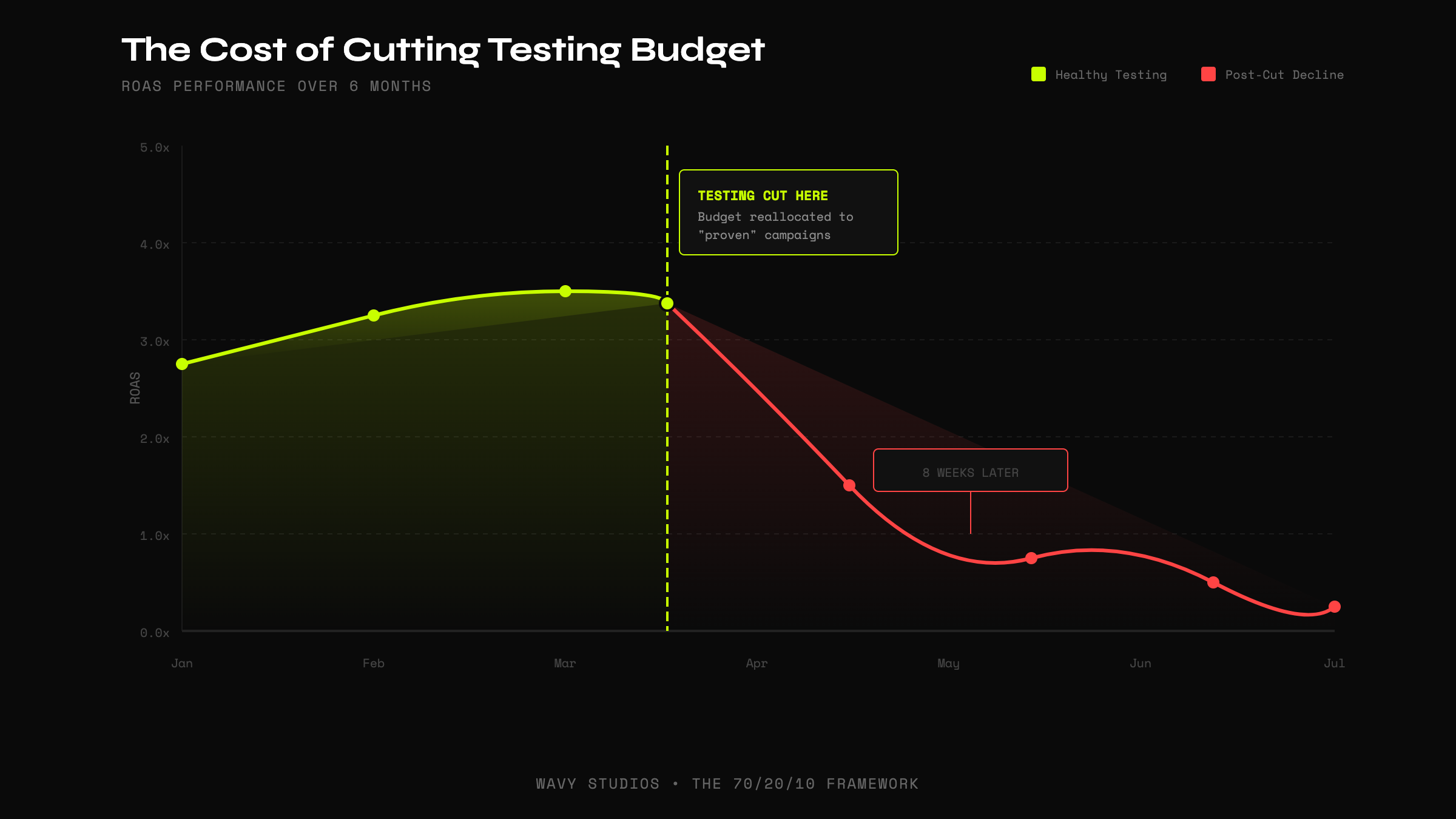
The moment performance dips, the first budget to get slashed is experimental spend. This feels rational in the moment. It's actually how you guarantee long-term decline.
Second-order consequence: You have nothing in the pipeline when your proven campaigns inevitably fatigue. You're forced to scale cold creative into a hostile auction with no validated angles.
A test shows early signal, maybe a 2.5x ROAS over three days, and the immediate instinct is to double the budget. But early signal is not proven performance.
Second-order consequence: Your team loses trust in testing because "tests never scale." The real problem was scaling prematurely.
The 70/20/10 Framework Explained
Here's how we actually allocate capital across the portfolio:
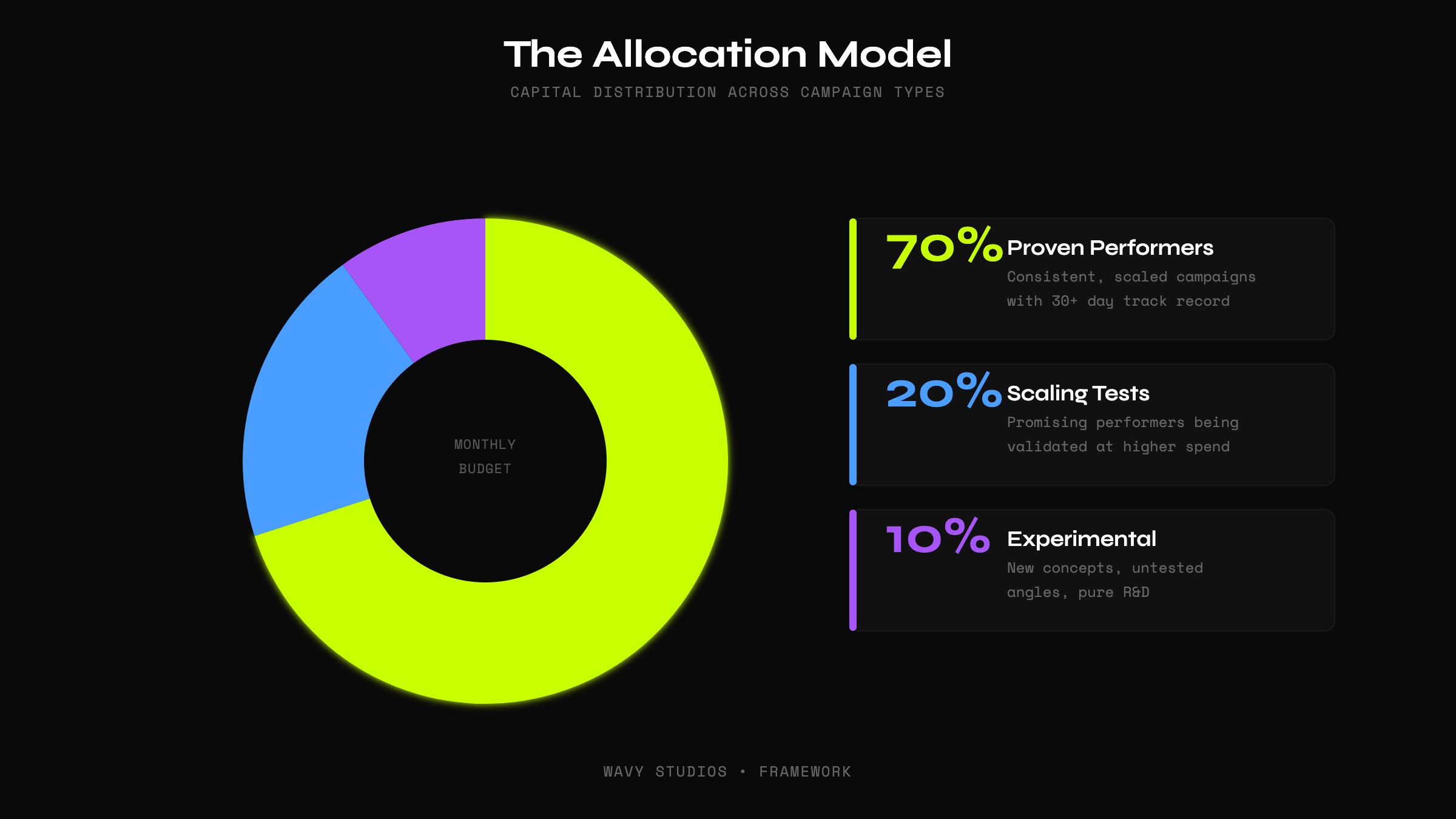
The Allocation Model
Campaigns profitable for 30+ days at target spend. Your workhorses. Extraction, not exploration.
7-14 days of positive signal. Earned more capital but haven't proven they perform at scale.
Asymmetric upside. New angles, formats, audiences. High failure rate, but tomorrow's 70%.
70% - Proven Performers
| Definition | Campaigns profitable for 30+ days at target spend |
| Objective | Maximize efficient volume |
| Risk Profile | Low. These have been validated |
| KPI Expectations | Within 15% of established benchmarks |
| Entry Criteria | 30-day track record, stable CAC/ROAS, scaled 2x without degradation |
| Exit Criteria | Performance declines 20%+ for 14+ days despite optimization |
20% - Scaling Tests
| Definition | Campaigns with 7-14 days of positive signal |
| Objective | Validate scalability |
| Risk Profile | Medium. Promising but unproven at scale |
| KPI Expectations | Within 25% of target metrics |
| Graduation Criteria | 30 days stable at 2x original budget |
| Kill Criteria | Performance degrades 30%+ when scaled |
10% - Experimental
| Definition | Unproven concepts with strategic hypothesis |
| Objective | Discover new winners |
| Risk Profile | High. Expect 70%+ failure rate |
| KPI Expectations | Any positive signal is a win |
| Graduation Criteria | 7+ days of promising signal |
| Kill Criteria | No signal after platform-minimum spend reached |
This bucket is not optional. Skip it and you're optimizing for the present while starving the future.
The Hidden Layer: Dynamic Reallocation
The 70/20/10 split is a baseline, not a mandate. Smart operators adjust ratios based on business context.
You don't have proven campaigns yet. You need more experimental surface area to find what works.
Risk: Higher volatility, but necessary for discovery.
You've found winners. Now you need to scale them faster while maintaining testing velocity.
Risk: Betting on current winners continuing to perform.
Survival mode. Concentrate on what's definitely working. Reduce experimental exposure.
Risk: Mortgaging future pipeline for present stability.
Your proven campaigns are degrading. You need more in the pipeline, faster.
Risk: Temporary efficiency loss for long-term health.
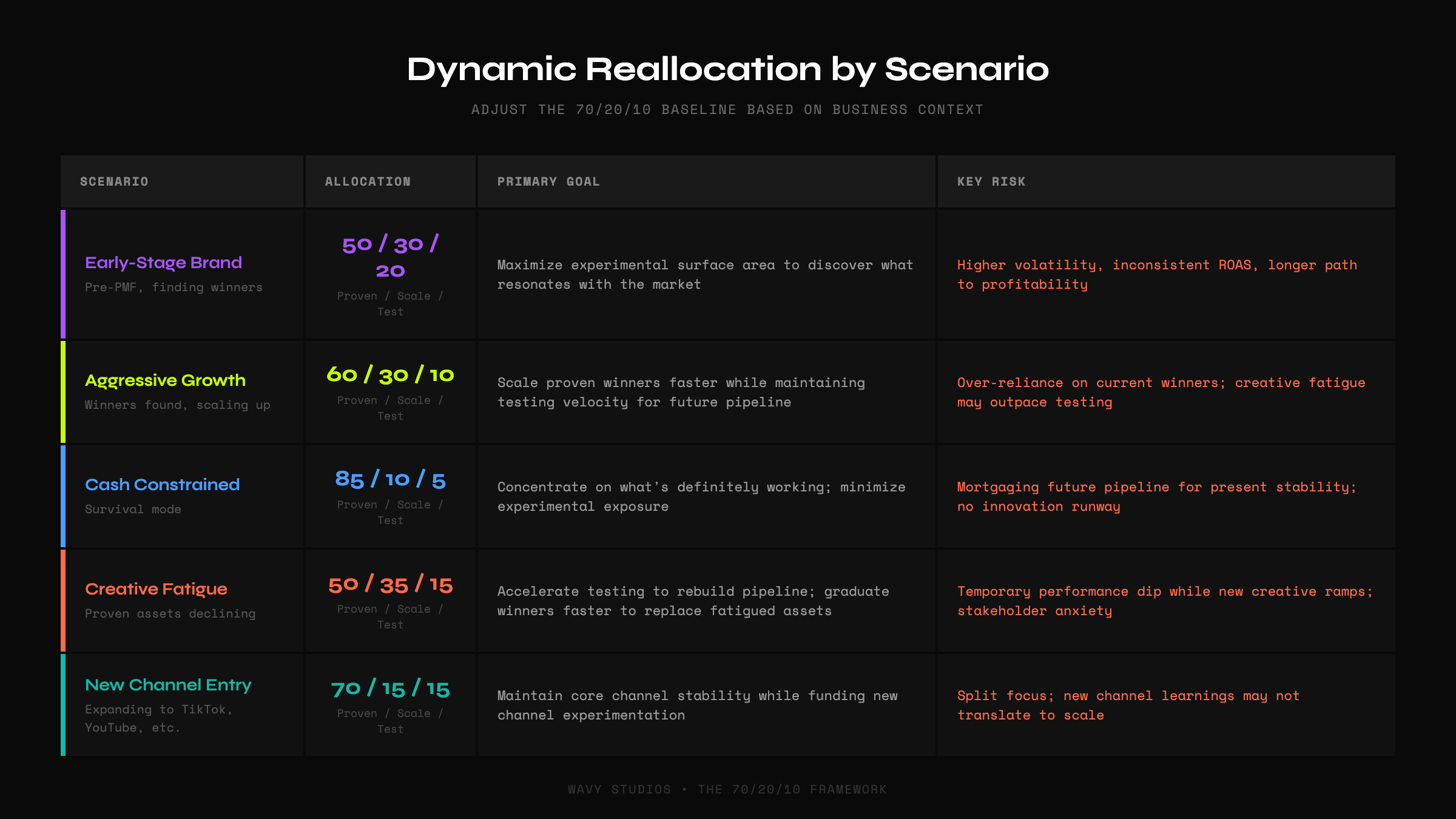
The point is not to memorize ratios. It's to understand that allocation should respond to business context, but within a disciplined framework, not ad-hoc reactions.
Implementation System
Theory is worthless without process. Here's how to operationalize this:
Weekly Budget Review Structure
Every Monday, review the entire portfolio through this lens:
- Categorize every active campaign (Proven / Scaling / Experimental)
- Calculate actual allocation percentages
- Identify campaigns ready for promotion or demotion
- Flag underperformers for kill decisions
- Confirm experimental pipeline is funded
This takes 30 minutes with proper dashboards. If it takes longer, your tracking infrastructure needs work.
Performance Thresholds
Define clear lines before you need them:
| Proven to Scaling demotion | 20% performance decline for 14+ days |
| Scaling to Proven graduation | 30 days stable at 2x budget |
| Scaling kill | 30% decline when scaled, or 21 days without improvement |
| Experimental graduation | 7+ days positive signal |
| Experimental kill | Platform-minimum spend with no signal |
Testing Velocity Targets
Your 10% experimental budget should produce:
- Minimum 4 new concepts tested per month
- At least 1 concept graduating to Scaling tier monthly
- Kill decisions within 7-14 days, not 30
If you're not hitting these numbers, either your experimental budget is too low or your testing process is too slow.
What This Changes
When you implement this framework properly, several things shift:
Emotional decisions decrease. You're not reacting to yesterday's performance. You're executing a system with predefined rules.
Downside is protected. 70% of budget is always in validated campaigns. You can't blow up the account with bad tests.
Innovation is preserved. The 10% is protected allocation. It doesn't get raided when things get tight (unless you're in true survival mode).
Compounding efficiency improves. Winners graduate into bigger buckets. Losers get killed fast. Capital flows toward performance, not history.
Capital discipline becomes cultural. Your team stops thinking in campaigns and starts thinking in portfolio management.
This is the difference between running ads and managing a growth system.
Actionable Summary
If you implement one thing from this article, make it this audit:
Operator Checklist
- Categorize every active campaign into Proven, Scaling, or Experimental
- Calculate your current allocation across those three buckets
- Identify dead weight: campaigns that don't fit any category or have been in Scaling limbo for 30+ days
- Define graduation criteria for Scaling to Proven
- Set reallocation triggers based on your business context
- Protect the 10%: if you don't have experimental budget, create it
Most brands will discover they're running 90% Proven, 10% random tests, 0% structured experimentation. That's not a portfolio. That's a slow decline waiting to happen.
The Real Skill
Most agencies will tell you the job is finding winning ads.
It's not.
The job is capital allocation. It's knowing where to deploy resources, when to scale, when to kill, and how to maintain a portfolio that compounds instead of churns.
Winning ads are the output. Capital discipline is the input.
Any team can stumble into a winner. Very few can systematically turn winners into sustainable growth engines while continuously developing the next generation of performers.
That's the difference between running paid media and building a growth system.
The 70/20/10 framework is how it starts.
Ready to audit your budget allocation?
Book a strategy call and we'll walk through your portfolio together.
Book Your Strategy Call →