Why Your ROAS Targets Are Probably Wrong
The math behind setting targets that account for LTV, contribution margin, and blended vs platform metrics. Most brands are optimizing for the wrong number.
A 3x ROAS Can Bankrupt You. A 1.8x ROAS Can Be Wildly Profitable.
Most performance marketers have their ROAS targets backwards.
They optimize for a number that looks good in a dashboard while bleeding money in the actual P&L. Or worse, they throttle spend on campaigns that are quietly building a profitable customer base because the platform metric doesn't clear some arbitrary threshold.
The problem isn't your media buying. It's your target-setting.
ROAS targets feel mathematical. They feel precise. But in most ecommerce organizations, they're set based on vibes: what the CEO heard at a conference, what a competitor mentioned on a podcast, or what "feels safe" after a bad quarter.
This article breaks down the actual financial mechanics behind setting ROAS targets that drive profit, not vanity metrics. We'll cover contribution margin, LTV, blended versus platform ROAS, and the payback period logic that separates financially literate growth teams from ad managers chasing dashboard numbers.
If you're managing paid media for an ecommerce brand and you haven't modeled your break-even ROAS from first principles, you're flying blind.
Why Most ROAS Targets Are Arbitrary
Here's how most brands set their ROAS target:
- The "feels safe" method: Pick a round number that sounds profitable. 3x? 4x? Sure.
- The competitor benchmark: Copy what a similar brand claims to hit.
- The platform default: Accept whatever Meta or Google's "good performance" threshold suggests.
- The historical anchor: Use last year's number because changing it feels risky.
None of these methods account for the financial reality of your specific business.
Here's what gets ignored:
- Contribution margin varies wildly. A 3x ROAS for a brand with 70% gross margin is very different from a 3x ROAS for a brand with 35% gross margin. Same ROAS, completely different profitability.
- Platform ROAS does not equal actual ROAS. Attribution models inflate results. The number you see in Ads Manager is not the number hitting your bank account.
- Retention economics change everything. If your customers come back, a "low" first-purchase ROAS can still be wildly profitable over 12 months.
- Cash flow timing matters. A profitable ROAS on paper can still create cash crunches if payback periods extend beyond your runway.
The second-order consequence: Brands set targets too high and strangle growth. Or they set targets too low and bleed cash while celebrating "scale."
Both failures stem from the same root cause: treating ROAS as a standalone metric rather than a financial constraint within a broader model.
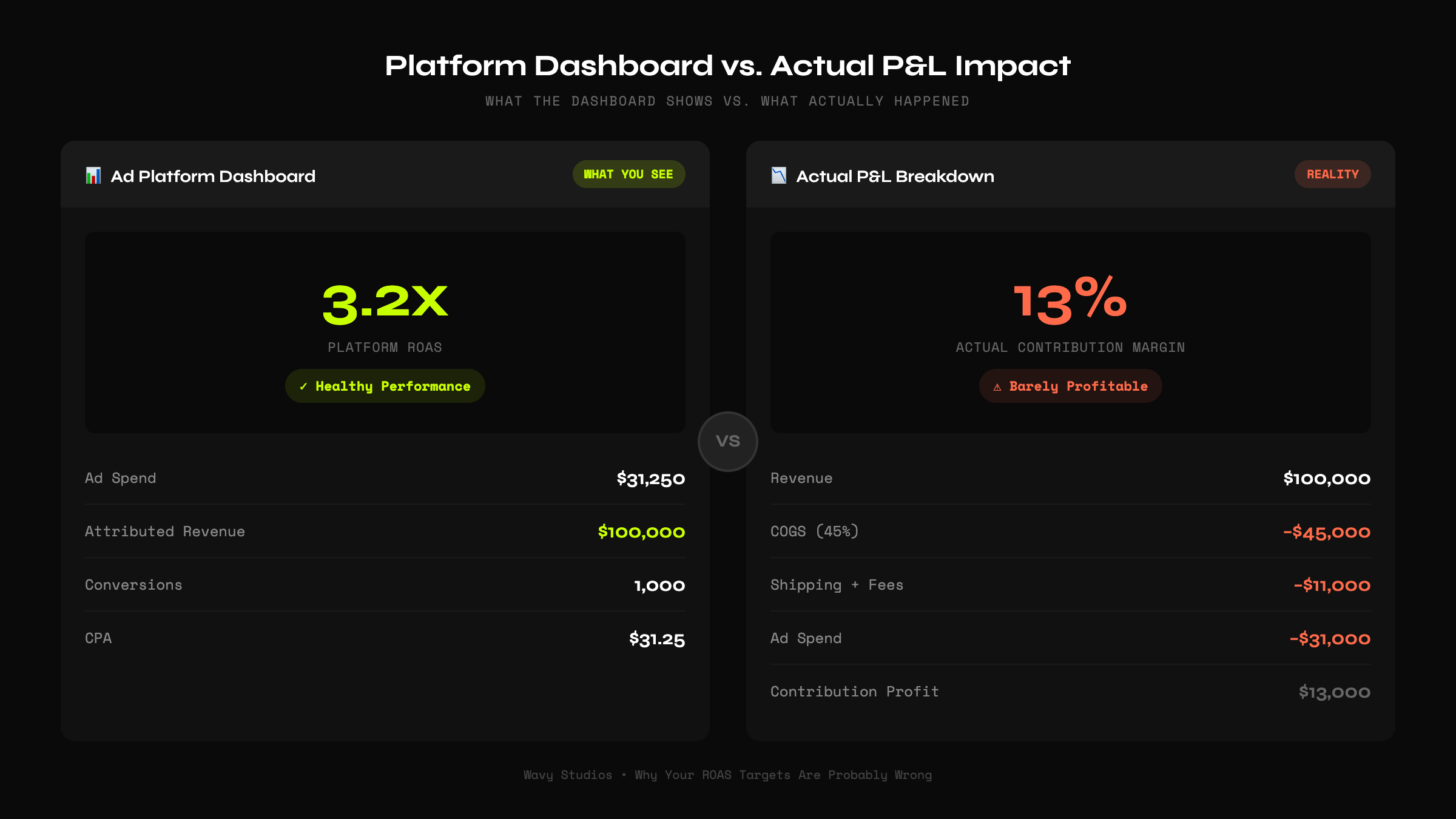
The Math Behind a Real ROAS Target
Let's build a ROAS target from financial first principles.
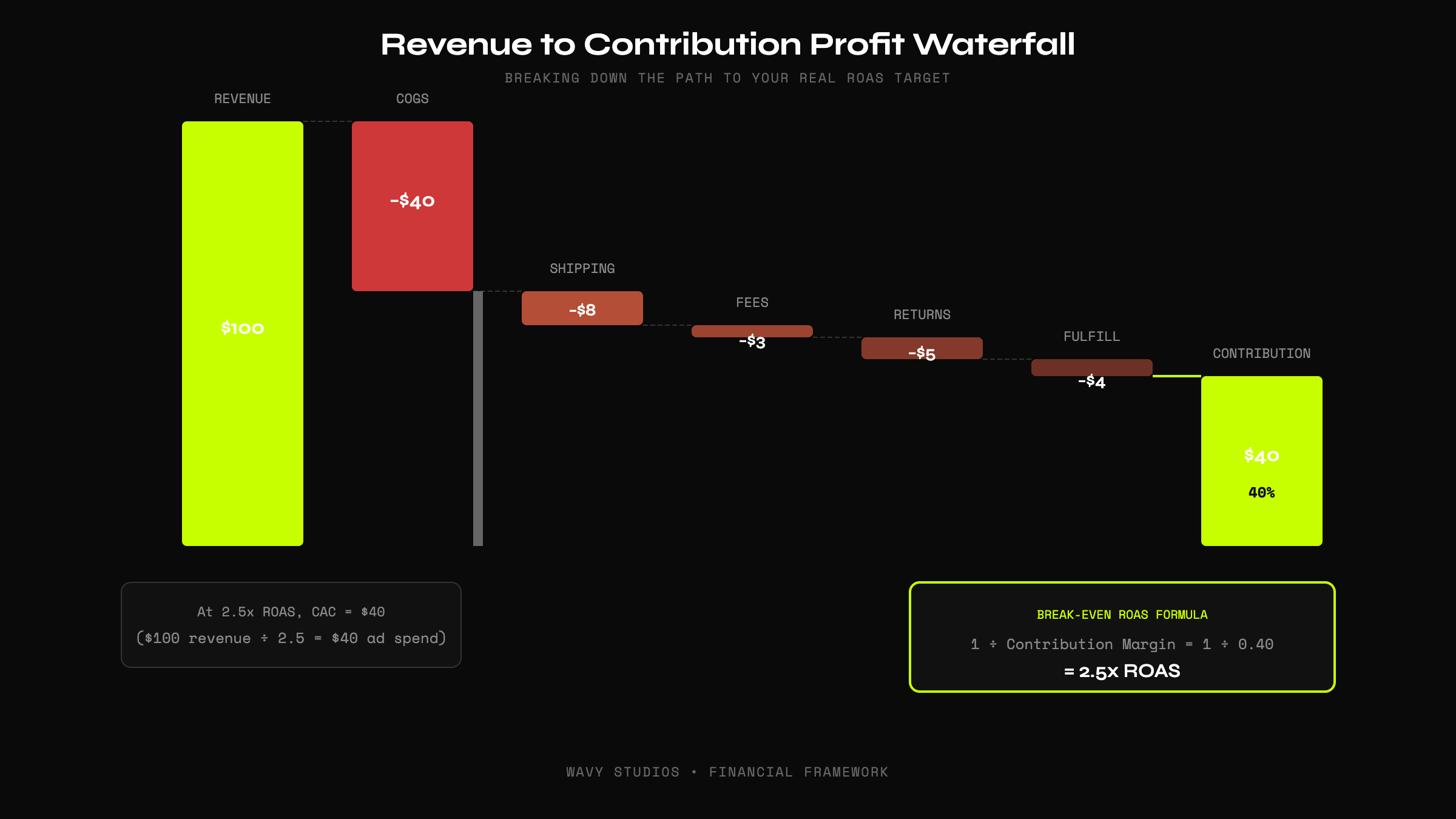
Contribution margin is what's left after you subtract all variable costs from revenue. Not gross margin, contribution margin.
The full waterfall:
| Line Item | Example |
|---|---|
| Revenue per order | $100 |
| COGS | $40 |
| = Gross profit | $60 |
| Shipping | $8 |
| Payment processing (3%) | $3 |
| Returns allowance (5%) | $5 |
| Variable fulfillment | $4 |
| = Contribution profit | $40 |
| Contribution margin | 40% |
Now apply the formula:
At 2.5x ROAS, this business breaks even on contribution, before fixed costs. Every dollar of ROAS above 2.5x generates actual profit. Every dollar below burns cash.
This is why generic ROAS benchmarks are useless. Your contribution margin structure is unique. Your fixed cost base is unique. Your target should be too.
Blended ROAS vs Platform ROAS: The Attribution Trap
Here's a truth most media buyers avoid:
Platform ROAS is a lie.
Not intentionally, but structurally. Every ad platform has incentive to claim credit for conversions. Attribution windows, view-through conversions, and cross-device modeling all inflate reported results.
What platform ROAS measures: Conversions the platform's model attributes to ads, divided by spend.
What blended ROAS measures: Total revenue divided by total ad spend. No attribution modeling. Just math.
The gap between these numbers reveals your incrementality problem.
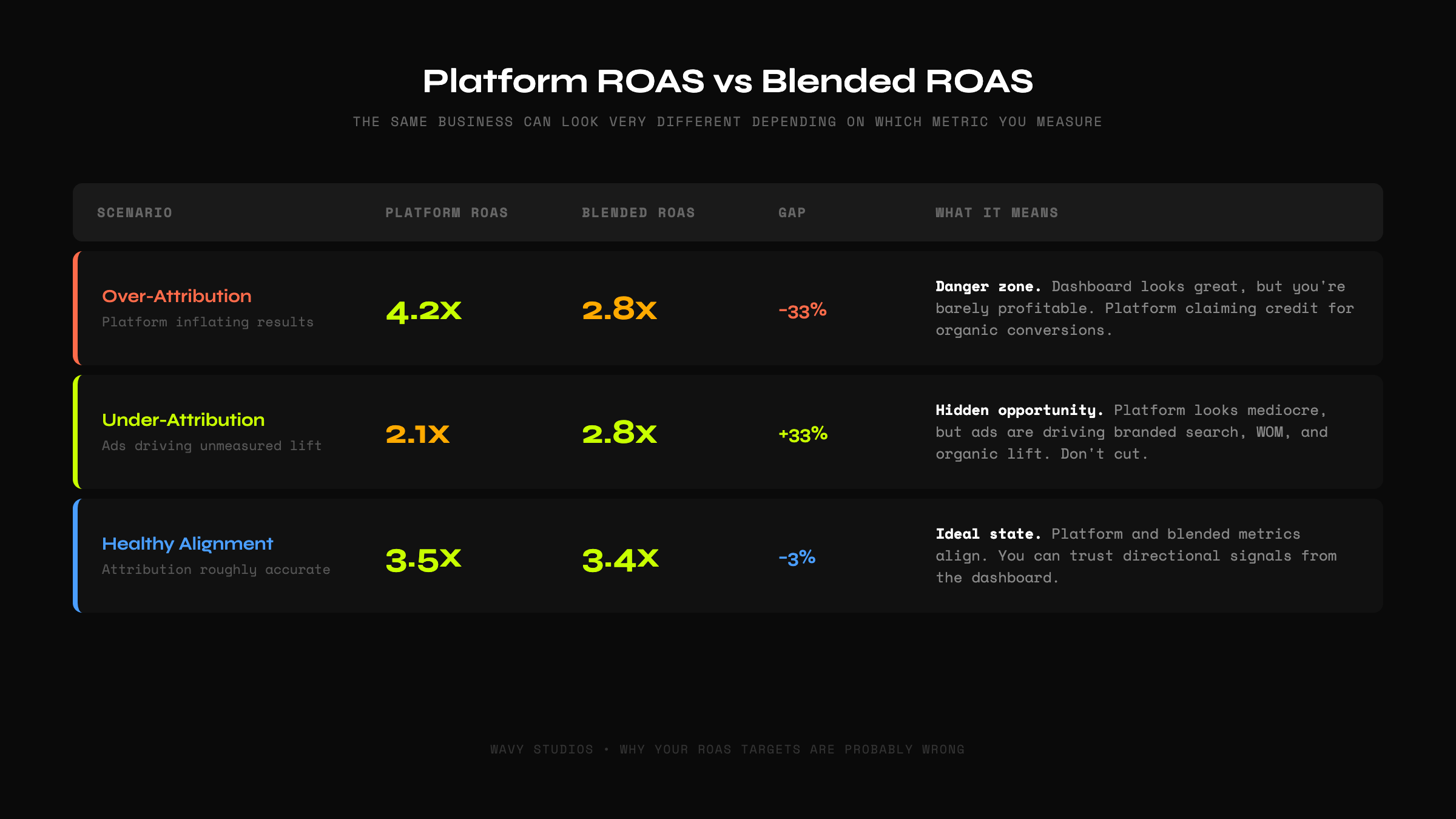
The operating principle: Set targets based on blended ROAS. Use platform ROAS for directional optimization within campaigns. Never confuse one for the other.
How LTV Changes Your ROAS Target
Everything above assumes a single transaction. But most ecommerce brands have repeat customers.
If customers come back, your acceptable first-purchase ROAS drops.
Here's the logic:
A brand with 30% 12-month repeat rate isn't acquiring a $100 customer, they're acquiring a $130 customer (on average). If contribution margin is 40%, that's $52 in lifetime contribution versus $40 from a single order.
If your LTV multiplier is 1.3x and contribution margin is 40%:
Suddenly, a 2.0x first-purchase ROAS is profitable, not a failure.
But there's a catch: payback period.
LTV is realized over time. If your average customer takes 8 months to generate their full value, you need the cash flow to survive those 8 months. A business with tight cash can't afford to wait.
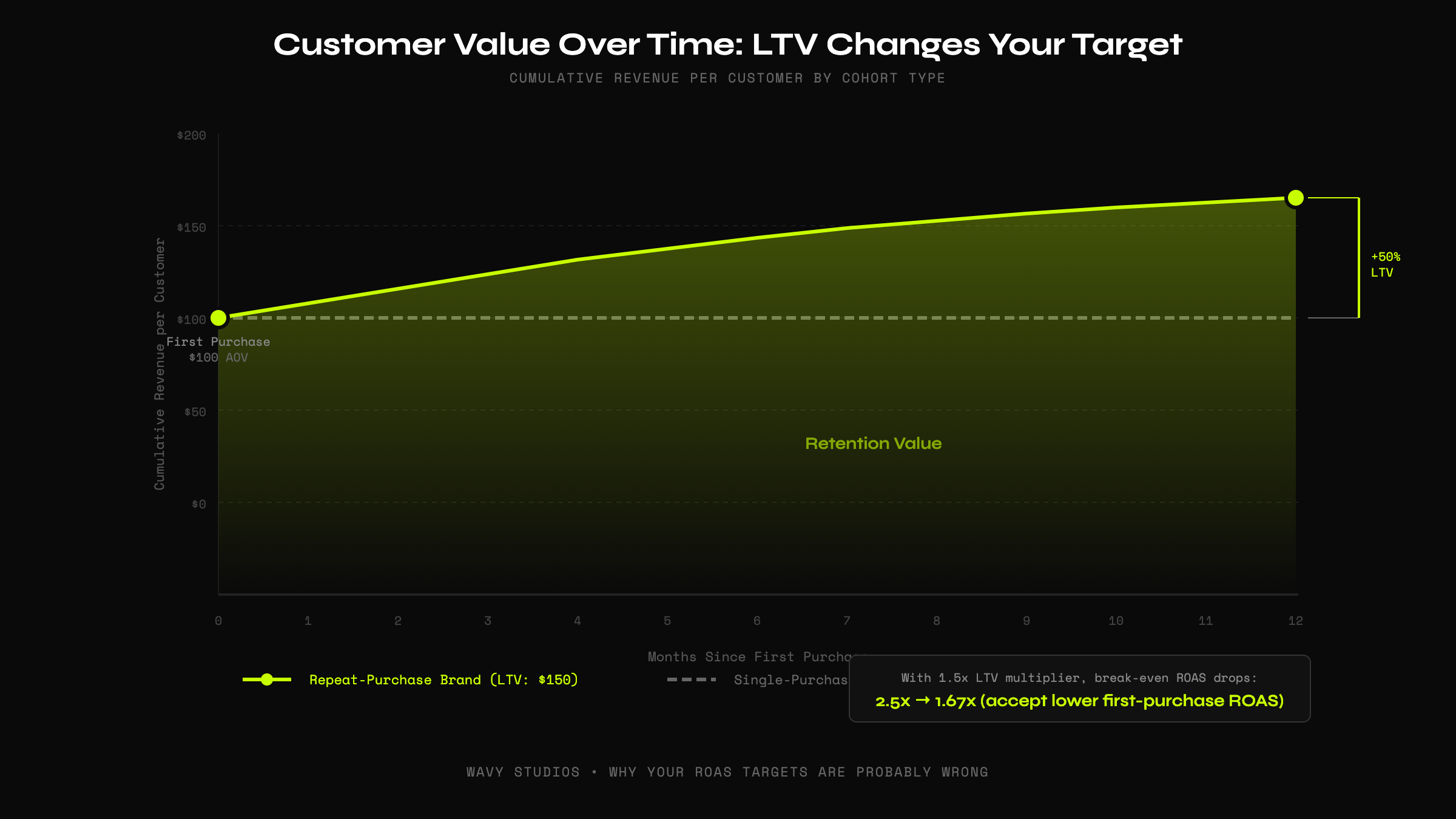
This is why subscription brands and consumables brands can run at seemingly "unprofitable" ROAS while building valuable businesses. They're playing a different financial game.
When Lower ROAS Is Actually Smarter
Not all growth phases have the same ROAS target.
- Scaling phase: When you've found product-market fit and have cash runway, accepting lower ROAS to capture market share often makes sense. You're trading short-term margin for long-term customer base.
- Survival phase: When cash is tight, ROAS discipline tightens. You can't afford to fund customer acquisition on credit.
- New customer acquisition: Acquiring new customers is almost always more expensive than retargeting existing ones. If your blended ROAS mixes both, your "new customer ROAS" is probably lower than the headline number. That's fine, if you're accounting for it.
- Creative expansion: Testing new angles, audiences, and formats requires accepting lower efficiency during the learning period. A strict ROAS target kills innovation.
The capital allocation lens: ROAS targets should flex based on your strategic phase, cash position, and growth objectives. A single static target is a sign of unsophisticated financial planning.
Practical Framework: How to Set Your Real ROAS Target
Here's the operator checklist:

- Calculate your true contribution margin -- Include all variable costs: COGS, shipping, payment fees, returns, variable fulfillment. Don't use gross margin as a proxy.
- Define your acceptable payback window -- How long can you wait for a customer to become profitable? 30 days? 90 days? 12 months? This depends on cash position and growth goals.
- Model your LTV multiplier -- What's your 12-month revenue per customer versus first-order revenue? Use actual cohort data, not assumptions.
- Calculate blended break-even ROAS -- Use the formula. Adjust for fixed costs if you want full break-even.
- Adjust for growth phase -- Aggressive growth: accept 10-20% below break-even. Stable growth: target break-even. Cash preservation: target 20%+ above.
- Set a testing tolerance band -- New campaigns need room to learn. Set a "testing ROAS floor" that's lower than your scaled target, typically 70-80% of target.
- Separate new customer vs blended targets -- If possible, set different ROAS targets for prospecting versus retargeting.
The Bottom Line
ROAS is not a goal. It is a financial constraint inside a broader growth model.
The brands that win don't chase arbitrary ROAS benchmarks. They understand their contribution margin, model their LTV, measure blended performance, and set targets that align with their strategic phase.
A 3x ROAS can bleed cash. A 1.8x ROAS can compound wealth.
The number doesn't tell you anything until you understand the math underneath it.
Set targets from first principles. Measure what matters. Build a business, not a dashboard.
Need Help Building Your Financial Framework?
Book a growth audit. We'll model your contribution margin, calculate your true break-even ROAS, and build a target-setting framework for your business.
Book Your Growth Audit →